Sustainable transport: decarbonizing without compromising the logistics chain
Rail route, close-to-stock management, flow control: how to reduce emissions from transport while preserving reliability and continuity of service. A tribune by Christophe Denjean.

Reducing the environmental footprint of transport seems, on paper, to be a fairly simple equation: prioritize the least carbon-intensive modes, reduce the kilometers traveled, and optimize vehicle loading. In reality, the transformation is more complex. After all, a logistics chain must also remain relevant, efficient, and agile.
This is undoubtedly one of the main lessons of the transformations undertaken in recent years: there is no single solution to reduce the environmental impact of transport. Rather, there is a series of adjustments that must be adapted to the flows, territories, and operational constraints.
Reduce emissions without losing reliability
Since 2023, we have reviewed several of our transport plans, especially for some remote areas, by developing a rail-road mix and by accompanying the evolution of the fleets and fuels used by our carriers.
For the affected flows, this transformation would have led to a reduction of approximately 40% % in CO₂ emissions between our warehouses and our customers, in France and Europe. This significant result demonstrates the significant benefits of changing logistics patterns when volumes and destinations allow for it.
But experience also shows that a decarbonization logic cannot be thought of independently of the continuity of service.
On some routes to the Southeast, we have managed to transit all the relevant volumes by rail. However, a system that is entirely dependent on the railway also becomes more vulnerable to disruptions: strikes, disruptions, or the immobilization of goods can quickly have consequences for customers.
We have therefore evolved this model towards an equilibrium of approximately 90 % rail-road and % 10 road sections. This road section retains a capacity to react in the event of disruption to the rail network.
This experience illustrates an essential reality: reducing emissions cannot be done without preserving a level of resilience sufficient to ensure the continuity of service. An environmentally efficient system, however, is unable to provide service in the event of an emergency and quickly reaches its limits.
Reduce the kilometers that do not need to be traveled
Limiting emissions related to transport does not only consist of changing the mode of transportation or the fuel used. The very organization of the logistics chain can have a significant impact.
With our new facility in Spain, we will bring our stock closer to the Spanish market and will eliminate, for the affected flows, part of the long-distance road transport previously carried out from northern France. Our initial estimates indicate a potential reduction in emissions of 15 to 20 %%, which we intend to consolidate based on the actual flows.
Environmental thinking therefore begins even before choosing a truck, train or boat, by questioning historical organizations: have we organized the journey in the most relevant way possible in view of the need to serve?
Better understanding of the flows to better manage them
This transformation also requires more accurate data.
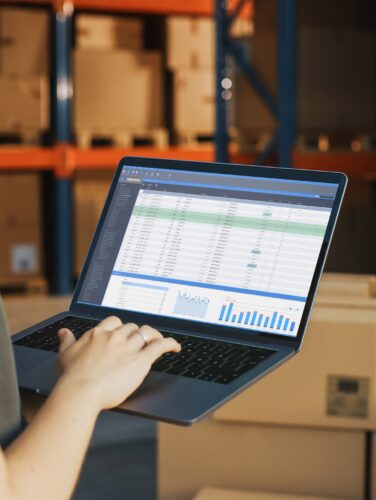
In recent years, the change in our transport management system has enabled us to centralize more delivery information and associated documents. In the long term, our ambition is to go further in tracking goods, with the goal of being able to geolocate 100 % of the pallets.
Visibility over flows primarily meets a customer expectation: knowing where a delivery is located and being better informed when an unexpected event occurs. It improves the quality of management: the more a company knows precisely its flows, the better it can identify anomalies, understand the uncertainties, and adjust its organizations. Finally, this deeper understanding must also enable it to anticipate certain events more effectively and respond more quickly when they occur.
In other words, the data does not decarbonize a journey alone, but it can help to better understand the flows and shed light on the decisions that concern their organization. More fine-tuning of the process leads to better optimizations and therefore, in the end, to reduce our emissions.
Relying on a diversified network of partners
Finally, talking about the transformation of transport requires us to look at the ecosystem that makes it possible.
JJA ships 1.2 million pallets per year and works with a panel of approximately 35 to 40 carriers and partners. Some have been with us for many years and have grown with the Group. For international shipments, we also work with major players capable of meeting significant volume and capacity needs.
This diversification of our partners is primarily driven by a goal of securing our capacity. By maintaining several operational carriers in our main basins and corridors, we have backup solutions in case one provider fails or becomes saturated. This organization complements our massification strategy, which aims to optimize loads, kilometers traveled, and associated emissions.
Finding the best balance, rather than the perfect solution
The reduction of transport-related emissions will therefore not be achieved through a single break. It will be achieved through a multitude of decisions: modifying a transport plan, bringing a stock closer to its market, integrating more rail when appropriate, changing fleets and fuels, optimizing loading and massing flows, improving knowledge of flows or retaining alternative solutions when a mode is disrupted.
The decarbonization of transport cannot be limited to a theoretical equation. It must confront available capacities, the constraints of territories, the requirements of customers, and operational uncertainties.
It is not a question of opposing environmental ambition and logistical performance, but of building organizations capable of making sustainable progress in both dimensions, without compromising the resilience of the logistics chain.
The real challenge is therefore not to find the perfect mode of transport. The real challenge is to build, flow after flow, the best balance between reducing emissions, operational efficiency and continuity of service.